



How Dredge Sled Design Influences Sediment Capture and Transport Efficiency
Effective lagoon and pond dredging relies on how efficiently equipment can capture, contain, and...
In heavy-duty pumping applications, submersible sludge pumps are rarely judged by flow rate alone. On active job sites such as construction dewatering pits, wastewater treatment facilities, mining tailings ponds, and industrial sludge transfer points, the real measure of performance is reliability under sustained stress. Abrasive solids, changing sludge densities, continuous submersion, and long operating hours place intense demands on internal pump components. Among these, seal systems and bearing systems have the greatest influence on how long a pump can operate without interruption.
For contractors and operators using rental equipment, internal pump design directly affects uptime, maintenance requirements, and overall project efficiency. A failed seal system can allow sludge or slurry to enter the motor chamber, while weak bearing systems can lead to shaft misalignment, vibration, and premature mechanical failure. These issues increase downtime and can disrupt critical operations when pumping is time-sensitive.
At Pump and Dredge Rentals, submersible sludge pumps are chosen and maintained with these operating realities in focus. The rental fleet is built for demanding sludge and slurry conditions where seal systems must resist abrasion and pressure, and bearing systems must remain stable under variable loads. This blog examines how seal systems and bearing systems function inside heavy-duty submersible sludge pumps, why they are essential to long-term reliability, and how proper equipment selection and maintenance support consistent performance across industrial pumping applications.
A submersible sludge pump is a compact but highly loaded system where every internal component operates under constant exposure to abrasive solids, hydraulic forces, and thermal stress. While external specifications such as motor power or discharge size are often highlighted, long-term performance depends on how well the internal systems are engineered to work together.
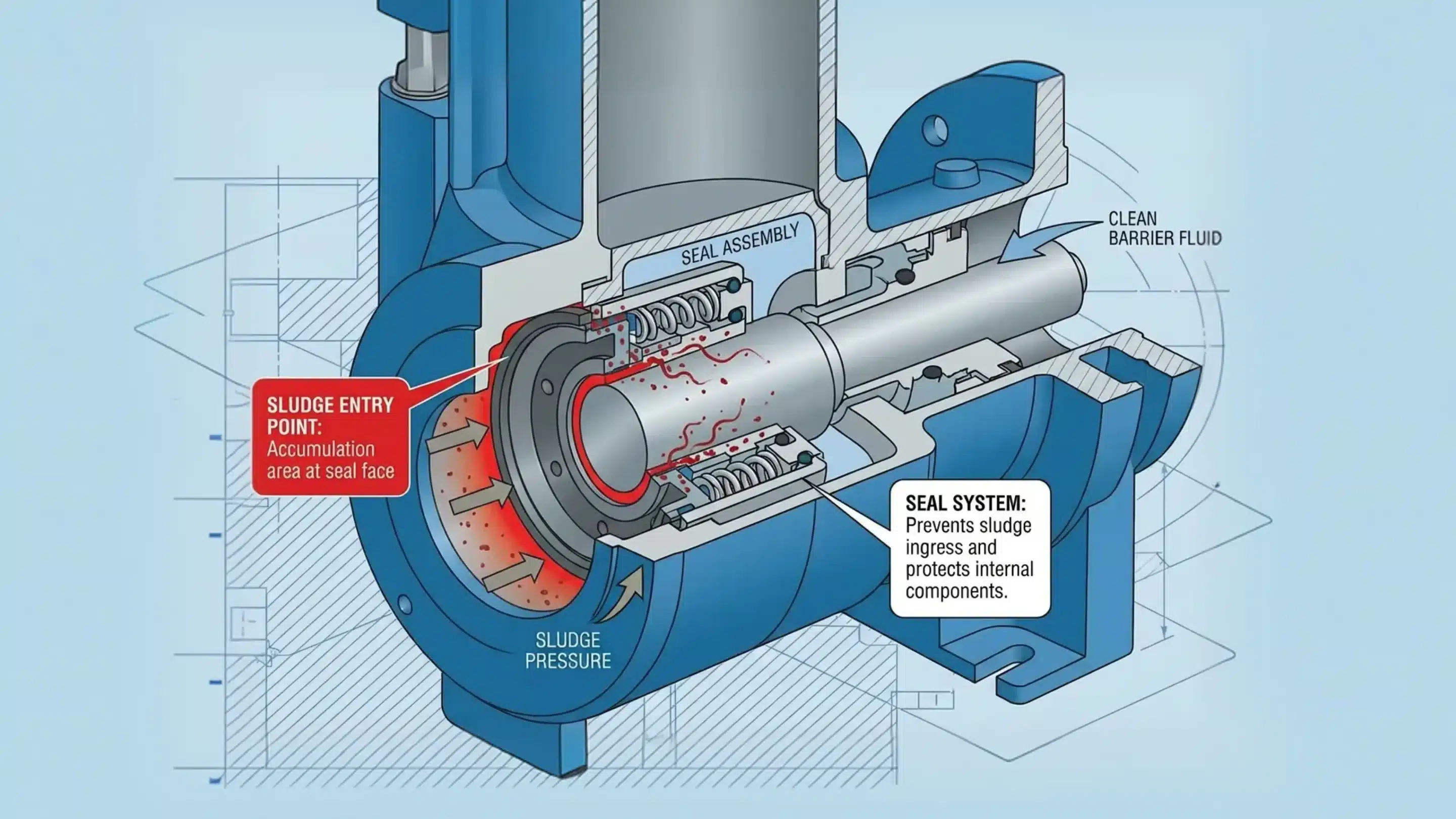
At the core of every heavy-duty submersible sludge pump is the motor-driven shaft assembly. This shaft transfers power from the motor to the impeller, which moves sludge containing sand, silt, gravel, or fibrous material. Surrounding this rotating assembly are two critical protection layers: the seal systems, which prevent sludge and water from entering the motor housing, and the bearing structure, which keeps the shaft aligned and stable during operation.
In sludge applications, the pump does not operate in a clean hydraulic environment. Solids impose uneven loading on the impeller, resulting in axial and radial forces that vary continuously during operation. The bearing structures absorb these forces. At the same time, abrasive particles migrate toward the motor chamber, testing the integrity of the seal structure with each shaft rotation.
This internal interaction is why seal structures and bearing structures cannot be viewed as standalone components. Their design, material selection, and positioning directly affect pump life, service intervals, and failure risk. For rental applications, where pumps may be deployed across multiple sites and conditions, this internal robustness becomes even more important.
Pump and Dredge Rentals structures its submersible sludge pump fleet around this mechanical reality. Pumps are selected with reinforced shaft assemblies, serviceable seal structures, and bearing structures designed to tolerate shock loads and variable sludge characteristics. This ensures consistent performance across demanding dewatering, sludge transfer, and dredging operations while minimizing unplanned downtime for rental users.
In heavy-duty submersible sludge pumps, seal structures are not secondary protection components. They are the first line of defense against total pump failure. Unlike clean-water pumps, sludge pumps operate in environments where abrasive particles, fine grit, and fluctuating pressures are always present. This makes seal performance a decisive factor in how long a pump can run before intervention is required.
A seal system’s primary role is simple in theory: prevent sludge and moisture from reaching the motor chamber. In practice, this is one of the most difficult tasks inside a submersible sludge pump. Solids continuously attempt to migrate along the shaft. Pressure conditions vary with sludge density. Heat builds up during long run times. Each of these factors places stress on the sealing surfaces.
Heavy-duty sludge pumps typically rely on mechanical seal arrangements rather than basic lip seals. In many applications, dual mechanical seal structures are used, often separated by an oil-filled chamber. This design allows the outer seal to absorb direct abrasion from sludge, while the inner seal protects the motor if the outer seal wears. The oil chamber also acts as a buffer, reducing heat and flushing fine particles away from critical surfaces.
Seal material selection is equally important. In sludge environments, seal faces must resist abrasion without losing flatness or sealing pressure. Hard materials such as silicon carbide are commonly used because they maintain integrity under both abrasive and thermal stress. Elastomers must also be compatible with the fluids being pumped and capable of handling continuous submersion without degradation.
From a rental perspective, seal system design must balance durability with serviceability. Pumps that require full disassembly to replace worn seals increase downtime and cost. For this reason, Pump and Dredge Rentals prioritizes submersible sludge pumps with a seal structure that can be inspected, monitored, and serviced efficiently. This approach reduces unexpected failures on-site and enables pumps to return to service quickly between jobs.
In sludge pumping, seal structures do not fail because they are poorly maintained. They fail because they are not designed for the environment in which they are placed. Understanding seal system behavior under real operating conditions is essential when selecting a submersible sludge pump that delivers consistent performance in demanding applications.
If seals are where sludge tries to get in, bearing structures are where the mechanical stress shows up first. In a submersible sludge pump, bearings deal with forces that are rarely steady. Sludge is not uniform. One minute, the pump is moving thin slurry; the next, it is pushing solids that hit the impeller unevenly. That imbalance travels straight into the shaft. Bearings keep the shaft where it belongs.
Radial bearings control side movement. Thrust bearings manage forward and backward forces created by the impeller. When either starts wearing faster than expected, the pump tells you quickly. Vibration increases. Noise changes. Heat builds. If the pump continues to run in that condition, seal life decreases and failure follows.
In sludge applications, bearing problems usually do not come from a single overload. They come from long hours, fluctuating loads, and fine solids that find their way into places they should not. Once contamination reaches a bearing, wear accelerates fast. At that point, replacement is not optional.
This is why bearing protection and lubrication matter as much as bearing size. Oil-lubricated, sealed bearing arrangements are far better suited to sludge pumping than open designs. They tolerate shock loads better and resist contamination longer, especially in pumps that are started, stopped, and redeployed across different sites.
From a rental standpoint, this matters more than most users realize. Pumps are not always used under ideal conditions. They may run dry briefly, handle higher solids than expected, or operate longer than planned. Pump and Dredge Rentals addresses this by using submersible sludge pumps with bearing structures designed for abuse, not just rated for performance.
Good bearing structures do not draw attention to themselves. The pump runs smoothly. Alignment holds. Maintenance stays predictable. That quiet reliability is what allows submersible sludge pumps to stay in service longer and return from job sites without turning into repair projects.

In heavy-duty submersible sludge pumps, seal and bearing failures are closely linked but typically do not occur simultaneously. One tends to trigger the other. On most sludge pumping jobs, seal structures fail first, and there are clear reasons for that.
Seal systems are in direct contact with the pumped media. Every abrasive particle, pressure fluctuation, and temperature change reaches the seals before it reaches anything else. Fine grit works against seal faces continuously. Fibrous material can wrap around the shaft. Pressure spikes occur when sludge density changes suddenly. Over time, this constant exposure wears the sealing surfaces down.
When a seal begins to degrade, the early signs are often invisible. A small amount of moisture enters the oil chamber. Lubrication quality drops. Heat increases slightly. If the pump continues running, contamination moves inward. At this stage, the bearing systems start to suffer, even though the root cause was the seal.
Bearing failure, on the other hand, is usually a secondary event. Bearings fail faster once contamination enters or once shaft alignment changes due to seal wear. Increased friction and vibration shorten bearing life quickly. In sludge applications, once bearings begin to degrade, the failure curve steepens. Noise increases, vibration becomes noticeable, and internal clearances close faster than expected.
There are also cases where bearing failure comes first, but these are less common. This typically happens when pumps operate under excessive load, run partially dry, or experience repeated shock loading. In such cases, bearing wear leads to shaft movement. That movement compromises the seal faces, causing seal failure shortly afterward.
The key point is that seal systems and bearing structures do not fail in isolation. In submersible sludge pumps, the pump functions as a combined protection and load-control system. When one is underspecified or neglected, the other follows.
This relationship is especially important in rental applications. Pumps may be pushed harder than planned, solids content may be underestimated, and operating hours may extend beyond original schedules. Pump and Dredge Rentals accounts for this by selecting submersible sludge pumps with robust seal systems that protect the bearing system and tolerate seal wear without immediate failure.
Understanding which component typically fails first helps operators respond correctly. Addressing early seal degradation can prevent bearing damage. Ignoring early bearing symptoms almost always leads to seal collapse. In sludge pumping, timing is everything, and knowing where failures begin can make the difference between routine service and a full pump rebuild.
Most seal and bearing failures in submersible sludge pumps are not sudden surprises. The signs usually appear early, but they are often missed because pumps are underwater, jobs are busy, and performance still appears acceptable on the surface. Knowing what to watch for makes a real difference, especially on long or high-risk pumping runs.
Seal-related issues tend to show up first, but not always in obvious ways. A slight rise in operating temperature, a change in oil condition, or the detection of moisture during routine checks are early indicators. In the field, this often gets overlooked because the flow rate remains steady and the pump is still moving sludge. By the time external symptoms appear, internal wear is already advanced.
Bearing problems announce themselves differently. Vibration is usually the first sign. It may start subtly and increase gradually. Sound changes are another indicator. A pump that used to run quietly may develop a dull rumble or irregular noise during startup or under load. These changes are often blamed on site conditions, but they usually point back to bearing wear or misalignment.
What makes sludge pumping difficult is that seals and bearings interact. A worn seal allows contamination that damages bearings. Worn bearings cause shaft movement that destroys seals. Treating one without considering the other rarely solves the problem for long.
From a practical standpoint, this is where rental equipment selection matters. Pump and Dredge Rentals maintains submersible sludge pumps with inspection-friendly designs. Oil chambers can be checked. Wear patterns are monitored between deployments. Seal and bearing condition is assessed before pumps return to service. This prevents borderline components from reaching failure while on a customer’s job site.
For operators, the takeaway is simple. If a pump sounds different, vibrates more than usual, or shows early signs of seal degradation, intervention should happen immediately. In sludge pumping, delays rarely save time. They usually multiply the repair scope.
Understanding how seal and bearing structures fail under real operating conditions enables better field decisions. It reduces downtime, avoids secondary damage, and keeps submersible sludge pumps operating where they belong, in the pit, not in the repair yard.

In rental environments, submersible sludge pumps are expected to operate across a wide range of conditions with minimal margin for error. A pump may move from a municipal dewatering project to an industrial sludge pit or a construction site within days. Each application introduces different solid content, run times, and operating stresses. Seal systems and bearing structures must be able to handle that variability without becoming a maintenance burden.
Unlike owned equipment, rental pumps are often deployed quickly and expected to work immediately. There is a limited opportunity for on-site tuning or extended commissioning. This makes internal reliability more important than peak performance. A pump that looks capable on paper but has vulnerable seal or bearing systems creates risk for both the rental provider and the customer.
Seal system resilience directly affects motor protection. In rental scenarios, pumps may be run longer than planned or under heavier solids loading than originally specified. Strong seal structure provides a buffer against these realities, reducing the likelihood of contamination-related failures. When seal systems are designed with service access in mind, routine checks and quick interventions become possible without removing the pump from service for extended periods.
Bearing systems affect how well a pump tolerates varying loads and operating conditions. Rental pumps experience more starts, stops, lifts, and relocations than permanently installed units. Bearings must withstand not only operational loads but also mechanical stress from handling and transport. Stable systems help maintain shaft alignment and reduce cascading failures caused by vibration or shock.
Pump and Dredge Rentals builds its rental strategy around this understanding. Submersible sludge pumps are selected, inspected, and rotated with close attention to seal and bearing conditions. Components approaching wear limits are addressed before redeployment, not after failure. This reduces on-site breakdowns and protects customer schedules.
For project teams, the benefit is straightforward. Reliable internal systems mean fewer interruptions, lower exposure to emergency repairs, and predictable pump behavior throughout the job. In demanding sludge applications, that predictability is often the difference between a smooth operation and a costly delay.

In sludge pumping, problems rarely start at the surface. They start inside the pump. Most field-traced breakdowns come back to the same cause: compromised or worn bearing systems in submersible sludge pumps.
When seals struggle, contamination follows. When bearings lose stability, everything else wears faster. Once that cycle starts, performance drops quickly. Flow might still look fine for a while, but internally, the pump is already moving toward failure.
This is why internal design matters more than headline specifications. Pumps that handle sludge day after day are not defined by horsepower or discharge size alone. They are defined by how well their seals hold under abrasion and how long their bearings stay aligned under uneven loads.
At Pump and Dredge Rentals, this reality shapes how equipment is selected, inspected, and returned to service. Pumps are expected to run in less-than-ideal conditions. Seal wear is anticipated, not ignored. Bearing condition is monitored before it becomes a problem on-site. That approach reduces surprise failures and keeps pumps working where they are needed, not sitting out of service.
For operators and project teams, the lesson is straightforward. If the seal and bearing systems are correct, most other issues remain manageable. If they are not, even a powerful submersible sludge pump becomes unreliable fast. Reliability does not come from the outside of the pump. It starts inside.
Effective lagoon and pond dredging relies on how efficiently equipment can capture, contain, and...
Mud pump rental has become a strategic choice across heavy industries, from oil and gas drilling...
Dredging equipment manufacturers are the driving force behind the innovation and reliability that...